How CIBIL Score is Calculated: Score Ranges (300–900) and Why 750 Matters
Your CIBIL score isn't random guesswork. It is a weighted mathematical algorithm calculated across five specific parameters. Here is exactly how it is computed, what score bands mean, and why 750 is the golden number for Indian borrowers.
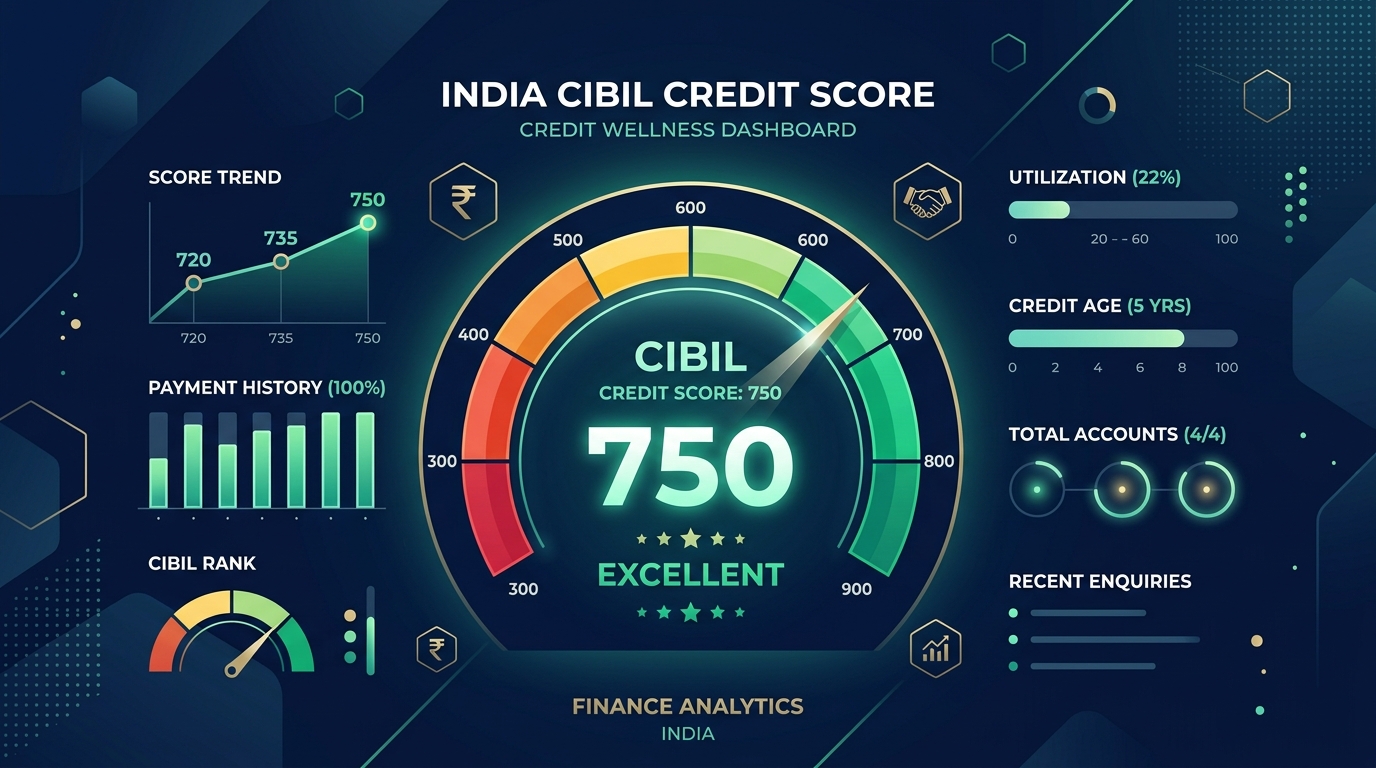
Whenever you apply for a credit card, personal loan, or home loan in India, the lender's underwriting system pulls your 3-digit credit score from TransUnion CIBIL (or companion bureaus Experian, CRIF High Mark, and Equifax). Ranging strictly between 300 and 900, this number dictates whether your application is instantly approved or flagged for rejection.
Yet, millions of borrowers remain confused about how this number is derived. Why does a single late payment tank your score by 40 points? Why is someone with a 747 CIBIL score treated vastly differently from someone at 750? And what exact mathematical formula determines your score?
In this guide, we break down the score calculation weights, the official CIBIL score brackets, and the banking mechanics behind India's lending thresholds.
CIBIL Score Ranges: What Your Number Actually Means
Indian banks (including SBI, HDFC, ICICI, and Axis Bank) classify credit profiles into five distinct score tiers:
| Score Range | Rating | Loan Approval Likelihood | Impact on Interest Rates |
|---|---|---|---|
| 750 to 900 | Excellent | Very High (>90% approval rate) | Prime interest rates, discounted processing fees, pre-approved offers |
| 700 to 749 | Good | Moderate to High (Approved with standard underwriting) | Standard rack rates; slight interest risk premium (0.20% to 0.50% higher) |
| 650 to 699 | Fair / Average | Low to Moderate (Requires co-applicant or collateral) | Higher interest rates; strict income verification and high scrutiny |
| 550 to 649 | Poor | Very Low (Mainstream bank rejection) | Referred to NBFCs or fintech apps charging 18% to 36% APR |
| 300 to 549 | Critical | Near Zero (Severe default / NPA history) | Flat rejection across all formal lending institutions |
Note: If you have zero credit history or your active accounts have been dormant for years, your credit bureau report may return -1 or NH (No History). This is not a bad score; it simply indicates that you have no credit footprint on file.
The 5 Factors: How CIBIL Calculates Your Score
While TransUnion CIBIL keeps its proprietary statistical regression model confidential, credit bureaus openly publish the approximate weighted parameters that form the scoring algorithm:
| Factor | Weight | What It Measures | How to Maximize It |
|---|---|---|---|
| 1. Payment History | ~35% | On-time EMI and credit card payments. Tracked through DPD (Days Past Due). | Never miss a due date. Even a 30-day delay gets flagged and stays on your report for 36 months. |
| 2. Credit Utilization Ratio (CUR) | ~30% | Percentage of total credit card limit utilized on your statement generation date. | Keep your total monthly statement balance under 30% (ideally below 10%) of your sanctioned limit. |
| 3. Credit History Length (Age) | ~15% | Average age of all open credit accounts and the age of your oldest active card. | Keep your oldest credit card active with occasional small recurring subscriptions. Never close your oldest account. |
| 4. Credit Mix | ~10% | Balance between secured credit (home loan, auto loan, gold loan) and unsecured credit (credit cards, personal loans). | Having only unsecured credit cards or instant loans can lower your score; a balanced mix shows multi-product discipline. |
| 5. Recent Credit Enquiries | ~10% | Number of "Hard Inquiries" logged when lenders check your CIBIL report for new credit. | Avoid applying for multiple cards or loans simultaneously. Space out new credit applications by at least 90–180 days. |
Why 750 is India's Magic Banking Cutoff
Under Reserve Bank of India (RBI) risk-based pricing directives, Indian scheduled commercial banks (SBI, Bank of Baroda, HDFC Bank, ICICI Bank) segment their floating interest rates directly by CIBIL credit score bands.
The cut-off point almost universally adopted across the industry is 750:
- Above 750: You are placed in Risk Band 1. You receive the bank's lowest publicized repo-linked lending rate (EBLR).
- Below 750: You fall into Risk Band 2 or 3, where banks slap an additional credit risk premium (markup) of 0.25% to 0.75% onto your base rate.
Consider a ₹50 lakh home loan over a 20-year tenure:
- Borrower A (CIBIL 750+): Sanctioned at 8.40%. Monthly EMI = ₹43,075. Total interest paid = ₹53.38 Lakhs.
- Borrower B (CIBIL 747): Classified in the tier below 750 and charged an 8.65% rate (just 0.25% extra risk spread). Monthly EMI = ₹43,865. Total interest paid = ₹55.28 Lakhs.
Those 3 missing points cost Borrower B ₹1,90,000 in excess interest plus higher upfront processing fees. If you are sitting at 740–748, paying down your credit card statement 5 days early can bump you across the 750 line within 30 days.
The 30% Utilization Rule: The Math Behind the Metric
Your Credit Utilization Ratio (CUR) accounts for roughly 30% of your overall score. It measures how much of your revolving credit you consume each billing cycle:
$$\text{CUR} = \left(\frac{\text{Total Credit Card Outstanding Balance}}{\text{Total Combined Credit Limit Across All Cards}}\right) \times 100$$
| Combined Credit Limit | Statement Balance | Utilization Ratio | CIBIL Impact |
|---|---|---|---|
| ₹1,00,000 | ₹10,000 | 10% | Optimal (Adds maximum positive score momentum) |
| ₹1,00,000 | ₹28,000 | 28% | Healthy (Within safe threshold, no penalty) |
| ₹1,00,000 | ₹55,000 | 55% | High (Reduces score by 15–30 points over 2 cycles) |
| ₹1,00,000 | ₹92,000 | 92% | Critical (Signals credit hunger; significant drop) |
Crucial Insight: CIBIL evaluates your balance on the statement generation date, not the final payment due date. Even if you pay off 100% of your bill before the due date, your bank reports the statement balance to CIBIL. To maintain a single-digit CUR, read our guide on the statement date vs due date timing trick.
CIBIL vs Experian vs CRIF High Mark: Why Scores Differ
Under RBI guidelines, all credit institutions must report borrower transaction histories to all four licensed Credit Information Companies (CICs) in India:
- TransUnion CIBIL (Oldest and most widely used by PSU & private banks)
- Experian India (Frequently used by fintechs and private retail banks)
- CRIF High Mark (Dominant in microfinance and two-wheeler/small loans)
- Equifax India (Used for commercial and retail banking)
You may check your credit score on a third-party app and see 785 on Experian, but find 730 on CIBIL. This difference is normal. Each bureau applies its own proprietary mathematical models and calibration scales. Most major mortgage and auto loan underwriters in India prioritize TransUnion CIBIL as their primary benchmark.
Next Steps: How to Rebuild a Sub-750 Score
If your CIBIL score is currently sitting at 500, 600, or 680, you do not need to pay expensive credit repair agencies. The path back to 750+ follows a predictable timeline:
- For a step-by-step month-by-month recovery plan, read our in-depth roadmap: How to Increase CIBIL Score from 500 or 600 to 750+.
- If you are balancing high-interest credit card debt and multiple personal loans, systematically paying down debt with our free local-first debt repayment companion PayoffPath can save you thousands in interest and quickly bring your utilization below 30%.