How to Increase CIBIL Score from 500 or 600 to 750+ (Month-by-Month Roadmap)
Whether your CIBIL score is sitting at 500 after a default, stuck at 600 from high card utilization, or sitting at a borderline 747, crossing 750+ is completely achievable. Here is the realistic month-by-month recovery roadmap.
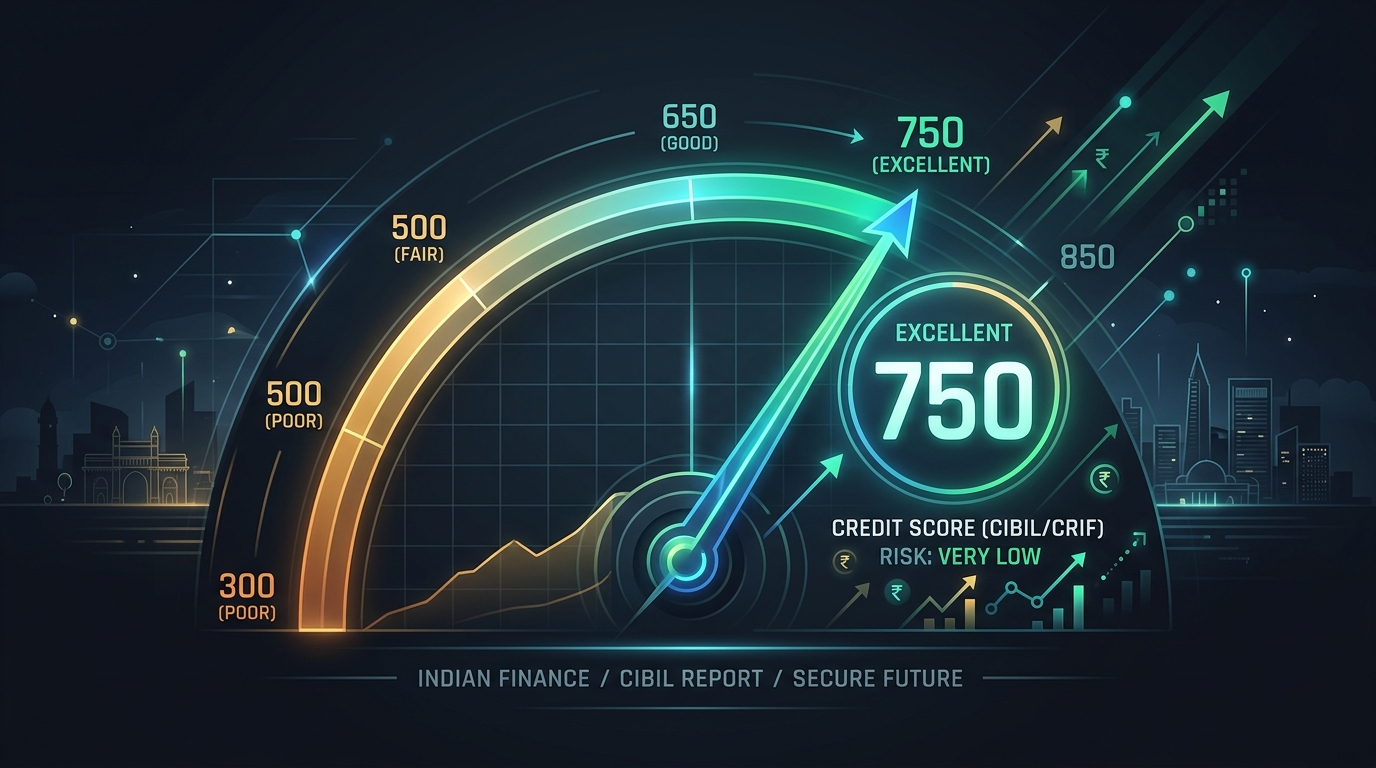
Few things are as frustrating as walking into an Indian bank for a car loan or home loan, only to hear the branch manager say: "Sir, your CIBIL is 610. The underwriting engine rejected your file automatically."
In India, 750 is the critical threshold. Banks like SBI, HDFC, and ICICI use 750 as the benchmark cutoff. Any score above 750 unlocks lower interest rates (often 0.5% to 1.0% cheaper on home loans), waived processing fees, and pre-approved personal loans. Anything below 650 pushes you into high-interest NBFC loans or flat rejections.
The good news? A damaged score is never permanent. Under Reserve Bank of India (RBI) mandates, all member credit bureaus (TransUnion CIBIL, Experian, CRIF High Mark, Equifax) receive updated repayment data fortnightly (at least every 15 days). If you take the right structured steps, your score will climb back up every single reporting cycle. To understand how bureaus weigh payment history vs credit utilization, read our breakdown on how CIBIL score is calculated and score ranges (300 to 900).
How Long Does It Take to Reach 750? (Timeline by Starting Score)
The time needed to reach a 750+ CIBIL score depends entirely on what caused your initial drop:
| Starting Score | Primary Cause | Realistic Timeline | Core Strategy |
|---|---|---|---|
| 500 to 599 | Severe defaults, 90+ DPD (Days Past Due), settled loans, written-off cards | 12 to 18 Months | Close open collections with clean NDC; rebuild credit history using a secured FD-backed card. |
| 600 to 699 | High credit card utilization (60%+), 1–2 late EMI payments, multiple loan rejections | 6 to 9 Months | Drop card utilization below 30%; dispute bureau reporting errors; zero fresh loan inquiries. |
| 700 to 746 | Moderate card balances, short credit history, minor bureau timing lag | 60 to 90 Days | Pay off balances before monthly bill generation dates; maintain on-time payment streak. |
| 747 to 749 | Borderline cutoff (just 1 to 3 points short of the prime 750 tier) | 30 Days | Prepay credit card before statement date; avoid closing oldest card account. |
What If Your Score is Borderline (e.g., 740 to 747)?
If you check your credit score and see 747 or 748, you might wonder: "Does 3 points really matter?"
In automated bank loan systems, yes. Many major Indian lenders program strict programmatic filters where interest rate concessions (e.g., SBI's best home loan rate bracket) activate strictly at CIBIL >= 750. A borrower with a 747 score might miss out on a 0.25%–0.50% interest discount that could cost lakhs of rupees over a 20-year loan tenure.
Here are three quick wins to gain those final 3 to 10 points within a single 30-day reporting cycle:
- The Statement Date Trick: Banks report your credit card balance to CIBIL on your statement generation date, not your payment due date. If your limit is ₹1,00,000 and you spend ₹40,000, pay ₹35,000 3 days before the statement generates. The bank will report a ₹5,000 balance (5% utilization) instead of ₹40,000 (40%), boosting your score on the next update.
- Do Not Close Old Credit Cards: Closing your oldest card shortens your average credit history and reduces your overall available limit, which temporarily depresses your score.
- Pause All Loan Inquiries: Don't check your eligibility on loan aggregator apps. Each inquiry triggers a hard pull that costs 3 to 5 points.
How to Maintain a Good CIBIL Score, and Can You Go from 750 to 800?
Once you are at 750 or above, there is no trick to reach 800. The score moves slowly and mostly rewards the same habits that got you there, kept up over a long time:
- Never miss or delay a payment. A single late payment on a card or EMI is reported and can undo months of gains. Set up auto-debit for at least the minimum amount, and pay the full bill when you can.
- Keep utilisation low and steady. The usual guidance is to stay below about 30% of each card's limit. Lower is better, and what is reported on your statement date is what the bureau sees.
- Let accounts age. Length of credit history counts. Keep your oldest card open, even if you use it only for a small recurring bill that you pay in full.
- Add credit only when you need it. Each new application creates a hard inquiry, and a burst of new loans or cards in a short time looks risky.
- Have a healthy mix over time. A history that includes both a loan and a credit card, repaid on time, is viewed more favourably than a file with only one type. Do not borrow just to improve the mix.
- Check your report once a year. Errors and wrongly reported accounts are fixable, as covered below.
Going from 750 to 800 therefore usually takes months or years of clean behaviour, not a single action. It is also worth asking whether you need it: many lenders' best-rate bands start at around 750, so the extra points often make little or no difference to your rate. Check your own lender's criteria before chasing a higher number.
How to Rebuild a CIBIL Score from 500 to 750
If your score has dropped into the 500s due to missed payments or emergency defaults, conventional advice like "pay your cards on time" is useless because banks will reject you for any standard card. Here is the exact two-step recovery playbook:
Step 1: Get a Secured (FD-Backed) Credit Card
Major Indian banks offer secured credit cards issued against a fixed deposit (FD), requiring zero credit score check and zero income proof:
- Open a small fixed deposit (e.g., ₹10,000 to ₹25,000) with banks like Kotak Mahindra (811 Dream Different), IDFC FIRST (WOW Card), or Axis Bank.
- You receive a real credit card with a credit limit equal to 80% to 100% of your deposit amount.
- Put small recurring purchases (like monthly electricity bills or groceries of ₹1,000 to ₹2,000) on the card and set up auto-pay in full every month.
- Every month you pay in full, the bank reports a positive repayment record to CIBIL. Within 6 to 9 months of spotless reporting, your score begins recovering rapidly into the upper 600s.
Step 2: Clear Past-Due DPD and Never "Settle" a Loan
When you have past-due penalties, collection agents might offer an OTS (One-Time Settlement): "Pay ₹25,000 against your ₹50,000 dues, and we will close the matter."
When you take a settlement, the bank reports your account status as "Settled" instead of "Closed". A "Settled" tag stays on your CIBIL report for up to about seven years and warns future lenders that you did not repay in full. Always negotiate for a waiver of penal interest, pay off the actual principal, and insist on a clean "No Dues Certificate (NDC)" with account status reported as Closed.
How to Increase Your CIBIL Score from 600 to 750
If your score is in the 600s, you don't need a full rebuild — your file usually suffers from high credit utilization or reporting errors. Use these high-impact levers:
1. The 30% Credit Utilization Rule
Your Credit Utilization Ratio (CUR) is the percentage of your credit limit you actually use. If you have an HDFC card with a ₹1,00,000 limit and your statement shows a ₹70,000 balance, your utilization is 70%.
Credit bureaus treat utilization above 30% as a sign of financial strain. To fix this:
- Keep your monthly bill below 30% of your limit: On a ₹1,00,000 limit, keep the billed balance under ₹30,000.
- Request a credit limit increase: If your bank offers a pre-approved limit increase from ₹1 Lakh to ₹2 Lakhs, accept it! If your monthly spending stays at ₹30,000, your utilization drops from 30% down to 15%, delivering an immediate positive score impact.
2. Stop Applying for Multiple Loans at Once (Hard Inquiries)
Every time you submit a loan application on an app or banking portal, the lender pulls your credit report. This is registered as a Hard Inquiry.
When multiple lenders submit hard inquiries within a few weeks, CIBIL's algorithm interprets this as credit-hungry behavior, knocking your score down. Compare loan interest rates anonymously without submitting your PAN, and formally apply to only one lender at a time.
3. Check for Errors in Your Free Annual CIBIL Report
By RBI mandate, every Indian citizen is entitled to one free full credit report per calendar year, per bureau from each credit bureau. Download your official report from cibil.com and check the "Accounts" section:
- Does an old loan you fully repaid two years ago still show as "Active" or "DPD"?
- Is there an unknown account listed under your PAN (identity mix-up or reporting error)?
If you spot a discrepancy, raise an online dispute directly on TransUnion CIBIL's grievance portal. Lending institutions are mandated by the RBI to resolve disputes within 30 days. Once the lender rectifies the record, the bureau updates your score in the subsequent fortnightly cycle, often producing a sudden jump of 30 to 50+ points.
Authoritative Regulatory Framework & Dispute Links
- Reserve Bank of India (RBI) — Master Direction on Credit Information Companies (Fortnightly Reporting Mandate)
- TransUnion CIBIL India — Official Consumer Dispute Resolution Portal