Debt Snowball vs Debt Avalanche: Which Payoff Strategy Saves More?
Comparing the Debt Snowball vs Debt Avalanche method? Here is the exact mathematical difference, interest savings, and a worked $25,000 example with numbers you can check.
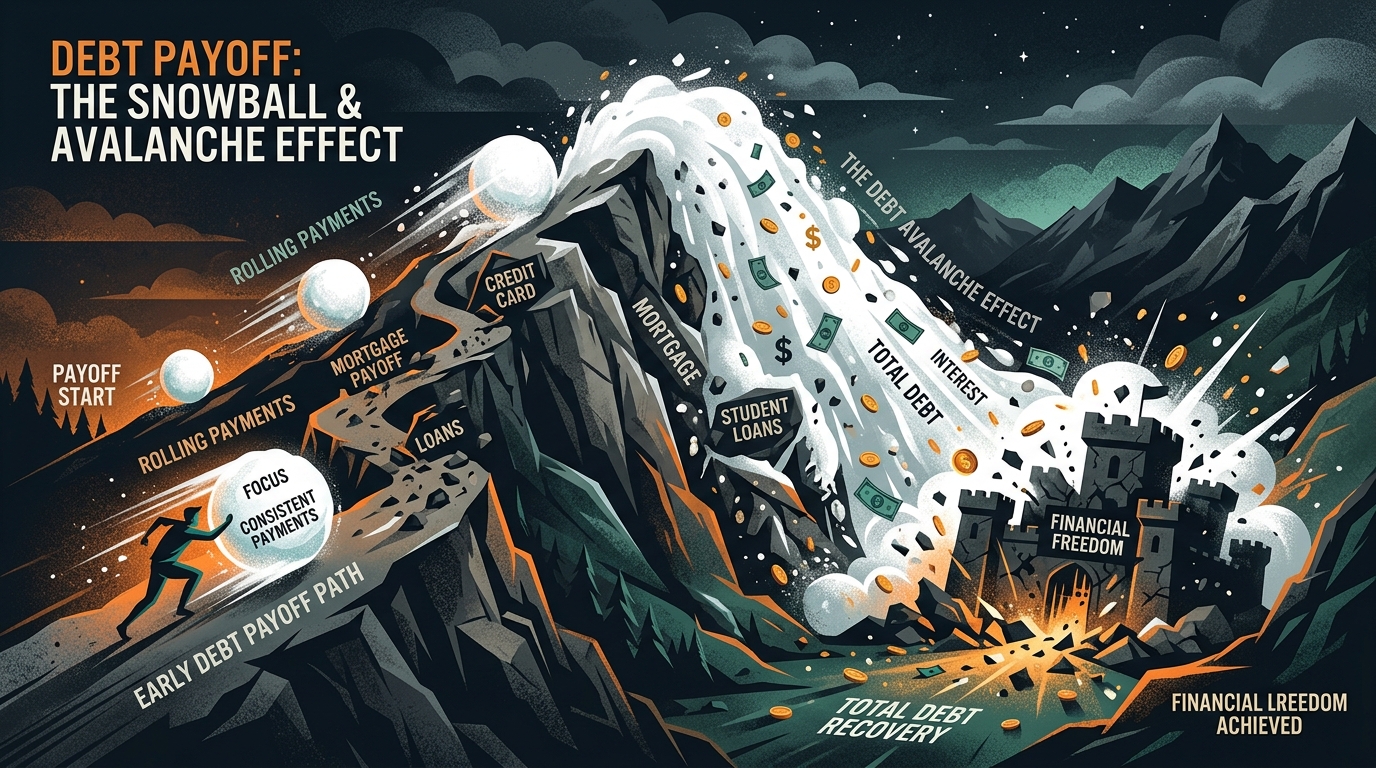
If you've ever stared at three different credit card statements and wondered, "Which one should I put extra money toward first?", you aren't alone. It is one of the most common dilemmas anyone faces when trying to get out of debt.
On paper, personal finance seems like pure math. But anyone who has lived through a tight budget knows that emotion, stress, and burnout matter just as much as interest rates. If a plan looks mathematically perfect but feels impossible to stick with, it won't work.
Debt Snowball vs Debt Avalanche: Quick Comparison
Here is how the two debt repayment methods compare at a glance:
| Comparison Point | Debt Snowball Method | Debt Avalanche Method |
|---|---|---|
| Repayment Order | Smallest balance to largest balance, regardless of interest rate | Highest interest rate (APR) to lowest, regardless of balance size |
| Core Principle | Behavioral Psychology: Quick early wins build momentum | Mathematical Efficiency: Minimizes total interest charges |
| Time to First Account Closed | Fastest (often within 30–90 days) | Slower (depends on the size of your highest-APR balance) |
| Total Money Saved | Good savings, but pays slightly more interest over time | Maximum savings (lowest possible interest paid) |
| Best Suited For | People who need quick encouragement and feel overwhelmed by many bills | Disciplined, numbers-driven planners motivated by saving money |
Let's Run a Real Example: A $25,000 Portfolio
To see how both methods work, let's look at a realistic household example with four common debts totaling $25,000. Suppose the minimum payments equal $700/month, and you have budget room to pay a total of $1,100/month (leaving you with $400 extra each month to throw at debt):
| Outcome Metric | Debt Snowball | Debt Avalanche | Exact Comparison |
|---|---|---|---|
| First Account Paid Off | Month 3 (Medical Bill) | Month 8 (Store Card) | Snowball delivers first victory 5 months sooner |
| Total Time to Debt-Free | 26 Months (2.17 yrs) | 26 Months (2.17 yrs) | Both methods clear debt in month 26 |
| Total Interest Paid | $3,495 | $3,188 | Avalanche saves $307 in interest |
Methodology & Parameters: Simulated on four active debts totaling $25,000 ($1,200 Medical @ 0%; $3,400 Retail @ 26.99%; $7,400 Bank Card @ 21.49%; $13,000 Auto @ 6.50%) with $700 baseline minimum payments and an extra $400/month budget ($1,100 total monthly allocation). Interest accrues monthly on active balances prior to payment application.
Mathematically, the Avalanche saves roughly $307 over the two-year journey. However, the Snowball eliminates an entire creditor from your life by Month 3, cutting down paperwork and anxiety early. If early wins keep you committed, that $307 difference is the best psychological insurance you can buy.
Which Method Should You Choose?
There is no single "right" answer. The best plan is the one you will actually finish.
Choose the Debt Snowball if:
- You feel overwhelmed by how many different bills you have to juggle every month.
- You need quick psychological wins to stay energized and motivated.
- You have previously started a budget and gave up after a few months.
Choose the Debt Avalanche if:
- You are naturally disciplined and love seeing numbers work efficiently.
- You have high-interest credit cards (24%+) that make you angry every time you see the interest charge.
- You don't mind waiting 6 to 9 months before closing your first account.
Can You Combine Both? (The Hybrid Approach)
Yes! In fact, many people find the hybrid approach works best:
- Pick one small balance (anything under $1,000 or $1,500) and wipe it out in 60 to 90 days. Enjoy the quick victory.
- Once that's done, immediately switch to the Avalanche method for the rest of your high-rate accounts.
Whether you choose the emotional momentum of the Snowball or the mathematical efficiency of the Avalanche, the most critical factor is consistency. Keep your numbers organized, automate your baseline payments, and celebrate every single debt you eliminate.
Authoritative References & Academic Research
- Harvard Business Review — Research: The Best Strategy for Paying Off Credit Card Debt (Gal & McShane)
- National Foundation for Credit Counseling (NFCC) — Debt Management & Payoff Guidelines